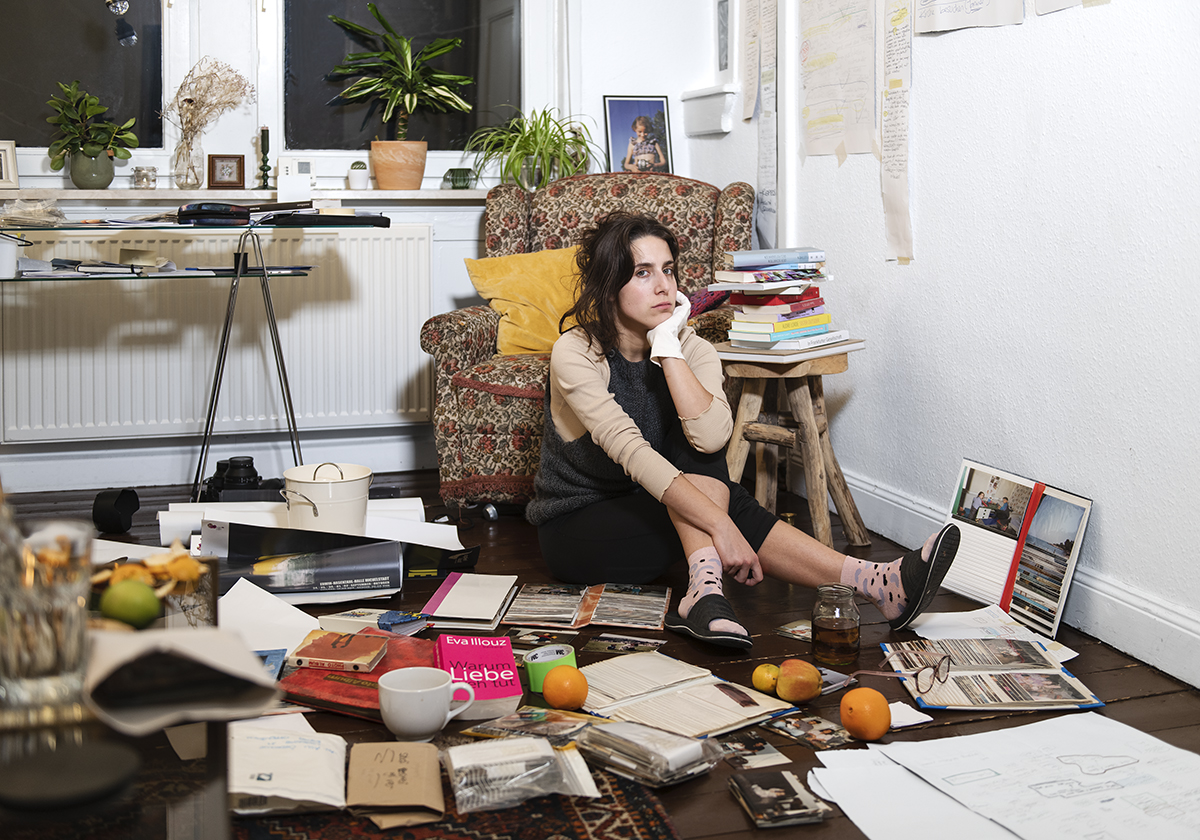
Aslı Özdemir
ICH KANN MICH JETZT ALS AKADEMIKER*IN TARNEN
(I can now camouflage myself as an academic)
Aslı Özdemir is an interdisciplinary visual artist whose practice operates at the intersection of intergenerational memory, empowerment, and a critical examination of the self in private and public spaces. She understands care—emek in Turkish—as both a political and aesthetic practice: a form of resistance, labor, and memory. Photography is her primary medium, which she uses as a means of intervention and re-inscription. Working with her family archive, she explores gestures, touches, and everyday objects as traces of embodied history. By cropping, enlarging, and rearranging these fragments, she fills in the gaps to reframe marginalized bodies and relationships as active subjects. Alongside this, she creates intermedial spatial installations, performances, and literary works that interweave photographic and bodily memory. Her photographic language oscillates between documentation and staging. Using luminous, symbol-rich still lifes as well as self- and family portraits, she examines habitus as an inscription of history—as continuity, repetition, and ruptures. In her portraits, she works with remote control, thus referring to a queer feminist canon that critically questions the medium on the level of the image.
In her work I can now camouflage myself as an academic, Aslı Özdemir reveals familiar gestures, touches, symbols, and interiors from her own family archive and the current living spaces of her family members. After months of looking at her family’s archive material and listening to the plural voices in it, she began to search for her own body, her own history in it. It was not only a search in the past, but also a locating in the present. She placed her body in the relationships and spaces. Her search had different levels: portraits with the self-timer, still lifes from the present, and excerpts from the archive material that she selected. These act as a bridge between times and the understanding of one’s own position within the family, but also within the social system. She uses remote control to make the power dynamics of the medium visible in the image. No one but the person portrayed is present in the room: the gaze goes out to the viewers, it demands.