Vanessa Amoah Opoku
Thresholds of Engineered Life
Vanessa Amoah Opoku is a German-Ghanaian interdisciplinary artist who transforms imperial surveying technologies such as LiDAR into relational tools. Her practice explores how diaspora and displacement, affecting bodies, species, and materials, develop their own cartographic technologies: systems for connecting across distances. Through fragmentary point cloud scans and their materialization in space, she creates multi-layered installations made of wax, textiles, and digital fragments that invite encounter.
She has been nominated for the European Commission's and Ars Electronica’s S+T+ARTS Prize 2025 and is part of the BPA// Berlin program for artists 26–27. Her work has recently been shown at Belvedere 21 Vienna, Deichtorhallen Hamburg, Fotomuseum Winterthur, EIGEN+ART Lab Berlin, and at the 18th International Triennial of Textile in Łódź. She teaches process design at HGK Basel FHNW. An artist's book will be published by DISTANZ in 2026.
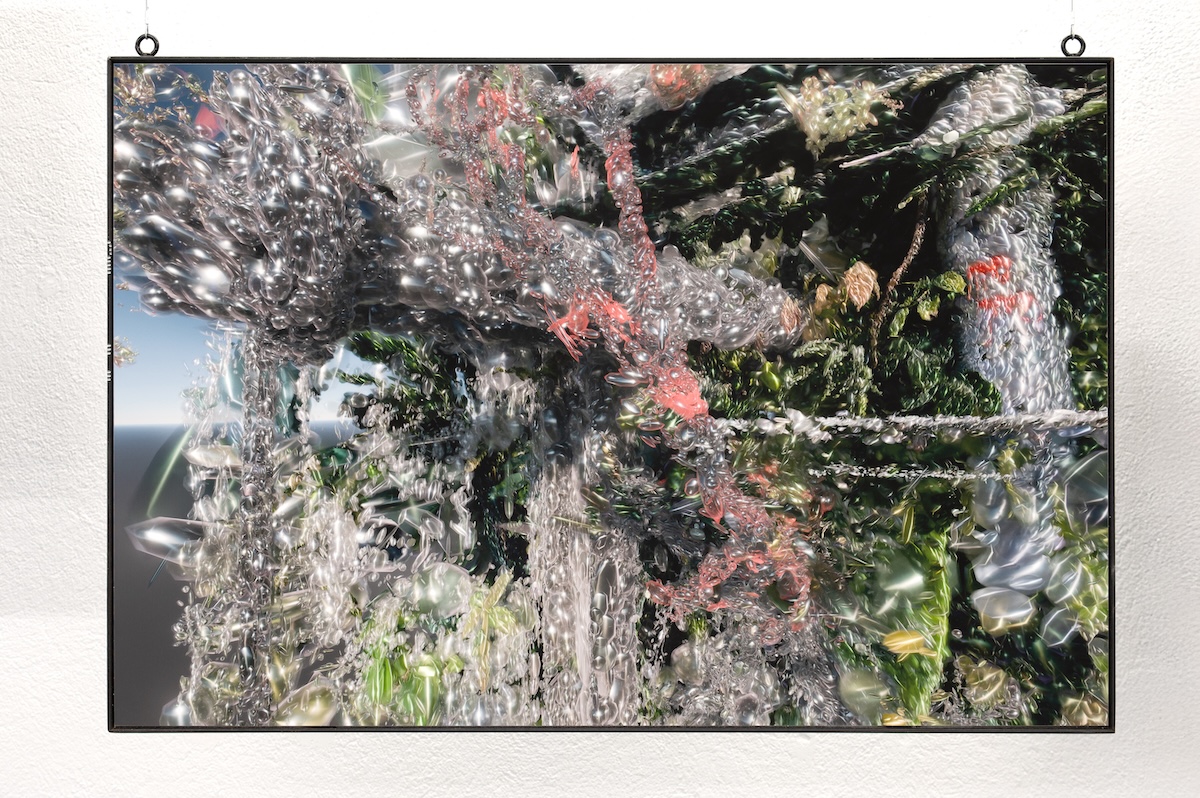
In her work, Vanessa Amoah Opoku focuses on the hidden systems that make the lush environments of tropical greenhouses possible. She draws attention to the pipes beneath the soil, the hissing misters, and the blinking sensors: technical infrastructures that reveal the control sustaining species far from their original habitats. Many plants were transported during colonial expeditions and preserved under glass. The greenhouse becomes a metaphor for ongoing extraction, orchestrating survival and performing nature as spectacle. To capture these spaces, she uses LiDAR, which measures by collecting thousands of points across surfaces. Historically, such methods have claimed territory, extracted resources, and enforced dominance. Today, they remain part of surveillance and extractive digital economies. She uses them to expose mechanisms of control through Gaussian splatting, which turns each measured point into a soft, semi-transparent fragment. Each fragment becomes a refusal to participate in extractive seeing, breaking the illusion of objective capture. In the virtual world, preserved plants overgrow their infrastructure and turn the inside outwards. Framed in hand-engraved steel, these images come to life through poetic fragments describing a sonic transformation. The sound of this reality emerges from field recordings of mechanized greenhouse environments and the sonification of scanned data. As point clouds accumulate and plants virtually overgrow their containment, mechanical orchestrations transform: synthetic frequencies bloom from coordinate data, algorithmic rhythms dissolve into organic textures. A sound interface employs e-ink technology—a deliberately slow, energy-minimal display that resists the smooth consumption of digital imagery. When sonic elements trigger visual responses, the screen’s inherent refresh delays and ghosting artifacts become poetic metaphors for technological irritation. Mechanical infrastructure appears in static portraits before dissolving into fractured traces, creating temporal overlays where past and present contaminate each other. The technology’s “failure” to deliver a smooth experience parallels the greenhouse’s deception: both promise perfect replication while revealing the seams of their constructed realities.